
Dharma In Modern World (Part 3). The Simplest Compass for Dharma vs. Adharma — A Story of Two Neighbours, a Nation at a Crossroads. [+AUDIO]
Why the refusal to ask questions threatens Dharma more than any disagreement.

Dear readers, you’ll notice something new on my Substack. Starting with this article, I am now including audio versions of my articles —narrated using my voice! Well, not exactly my voice, but a version generated by AI trained on my voice. I hope you’ll like it! Podcasts will be starting soon too, so stay tuned. And please share your thoughts and ideas in comments below —I read and value all of them!
Below is the third article in my series exploring Vedic concepts of Dharma and Karma as they apply to modern life. This one is built from a quote (a maxim) and a parable (a short anecdotal story) that I saw in my dream, and the two key points that I wanted to discuss with you, my readers:
It is not the questioning that causes doubt, but the refusal to allow the question.
And:
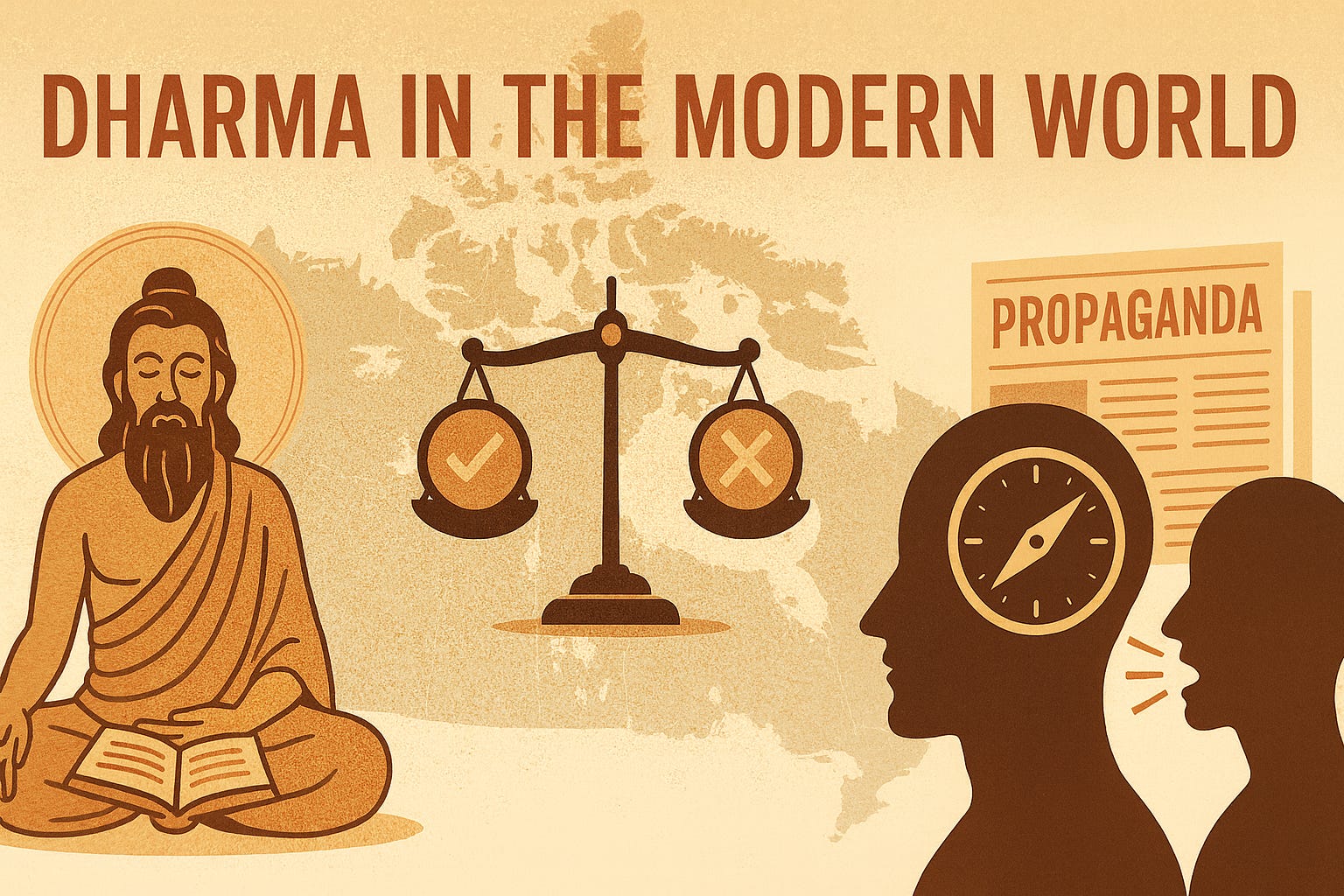
Following Dharma requires a moral compass that propaganda tries to break.


Listen to the article (online or offline):
A Nighttime maxim, a Parable, and a Nation at a Crossroads
A few days ago, during one of my nighttime awakenings, a maxim ( a short, sharp, succinct phrase expressing a general truth) came to me.
It arrived with a clarity that I can only describe as instructional:
“It is not the questioning vaccine safety and efficacy that causes doubt, but the refusal to allow the question.”
This line stayed with me because it seemed to perfectly express the moral crisis of our time. It felt like a litmus test — the simplest compass — for distinguishing Dharma (right action) from adharma (wrong action):
A society aligned with Dharma allows questions, protects questions, and welcomes them. A society moving away from Dharma treats questions as threats.
During the past five years, it has become increasingly clear that the central issue was never “vaccine hesitancy.” It was the prohibition against asking questions related to safety, ethics, proportionality, and long-term consequences. The real trauma arose not from scientific debate, but from the denial of debate.
And this is where Dharma becomes essential:
Dharma begins where truth can be spoken.
Adharma begins where truth is forbidden.
A Story of Two Neighbours
On another night, just before waking, I saw the following imaginary scene in a dream:
Two neighbours meet on the street. Each shouts at the other:
“You are wrong!”
“No, you are wrong!”
Option 1:
They walk away, angry, convinced of their righteousness, never speaking again.
Option 2:
A third neighbour passes by and says:
“You are both right. Have a good day.”
Both neighbours pause. The tension dissolves.
They continue their lives peacefully, each holding their truth without needing to erase the other’s.
This small parable captures the essence of a functioning society:
It is not agreement that allows us to live together.
It is the space to disagree without needing to destroy.
Now ask:
Which of these two options resembles Canada today?
We no longer debate; we fracture.
We no longer ask; we obey or rebel.
We no longer meet as neighbours; we meet as factions.
And most tragically, we no longer tolerate the person who simply says,
“I have a question.”
Dharma as the Compass in Times of Propaganda
In an age of propaganda and institutional narratives, Dharma offers one of the few remaining moral compasses.
Dharma says:
Let the truth be spoken.
Let the question be asked.
Let disagreement exist without punishment.
Let conscience—not fear—guide action.
Let the dignity of every human being be preserved even in conflict.
Propaganda seeks the opposite:
Silence the question.
Shame the dissenter.
Reward the conformist.
Punish open reasoning.
Replace conscience with slogans.
The issue is not whether a person supports or opposes a policy.
The issue is whether the space for questioning still exists.
A society that punishes questions moves away from Dharma.
A society that protects them moves toward it.
Karmic Consequences for Individuals and Nations
The Vedic scriptures teach that Karma does not fall only on individuals.
Nations also bear consequences when they abandon Dharma.
When a government, an institution, or a media system:
refuses open inquiry
attacks those who ask reasonable questions
suppresses scientific transparency
normalizes coercion or shame
rewards conformity over conscience
it plants seeds of long-term decline.
The Mahabharata teaches that consequences may not appear in the same generation—but they inevitably appear in the next. Children grow up in the moral environment we build. If we construct a culture of fear and silence, their moral landscape becomes narrow. If we preserve a culture of questioning and dignity, they inherit strength.
This is the karmic truth:
A nation cannot escape the consequences of suppressing truth.
Not immediately, perhaps—but inevitably.
Which Path Will We Choose?
Returning to the parable:
Canada today resembles the first path—neighbours who no longer speak, each convinced the other is wrong, with institutions encouraging this division.
But we could choose the second path.
We could choose:
humility over certainty
inquiry over obedience
compassion over polarization
conscience over propaganda
Dharma over fear
We could say to one another:
“You may be right.
I may be right.
Let us talk.”
This would be the beginning of healing.
Disclaimer
This article represents the author’s personal reflections and does not express the views of any institution.
It does not give legal or medical advice.
Its purpose is to explore moral philosophy in the context of contemporary events.
Acknowledgment
This article was written with assistance from ChatGPT . Based on approximately 25 minutes of narrated input and collaborative drafting with the author.
ChatGPT was also used to ensure factual neutrality and alignment with the Public Servant Code of Values and Ethics.
Read more about why and how I use ChatGPT to write my Substack articles here:
https://ivim.substack.com/p/writing-with-integrity-how-i-use
Support This Work Across All Channels
If you believe in open dialogue, informed choice, and exploring underreported perspectives, please consider sharing this article.
You can follow and support my work here:
My articles are, and will always remain, free to read. Your shares, comments, and subscriptions help more people discover this work.